(PRH) The Platonic Representation Hypothesis
Appreciation
7
Importance
8
Date Added
6.13.26
TLDR
Argues that there is a universal representation of reality that AI models, as they grow more generally competent (and agnostic to architecture, training objective, and modality), are converging towards. Intuitively, the number of representation spaces a model can adopt to solve many different tasks gets smaller as the number of tasks goes up. That is, the three pressures for convergence are 1) multitask competence (representation must work for different objectives), 2) capacity (larger models are more likely to contain the optimal representation), 3) bias toward simpler representations.
2 Cents
The figures in section 3 are easy to understand and the bulk of the paper’s point.
Tags
What’s useful from this paper:
- If representations really do converge, then we can leverage internet-scale data for building representations of the brain by learning a map from spikes into an already established concept space, which is a much cheaper objective than building the space.
Doubts/criticisms:
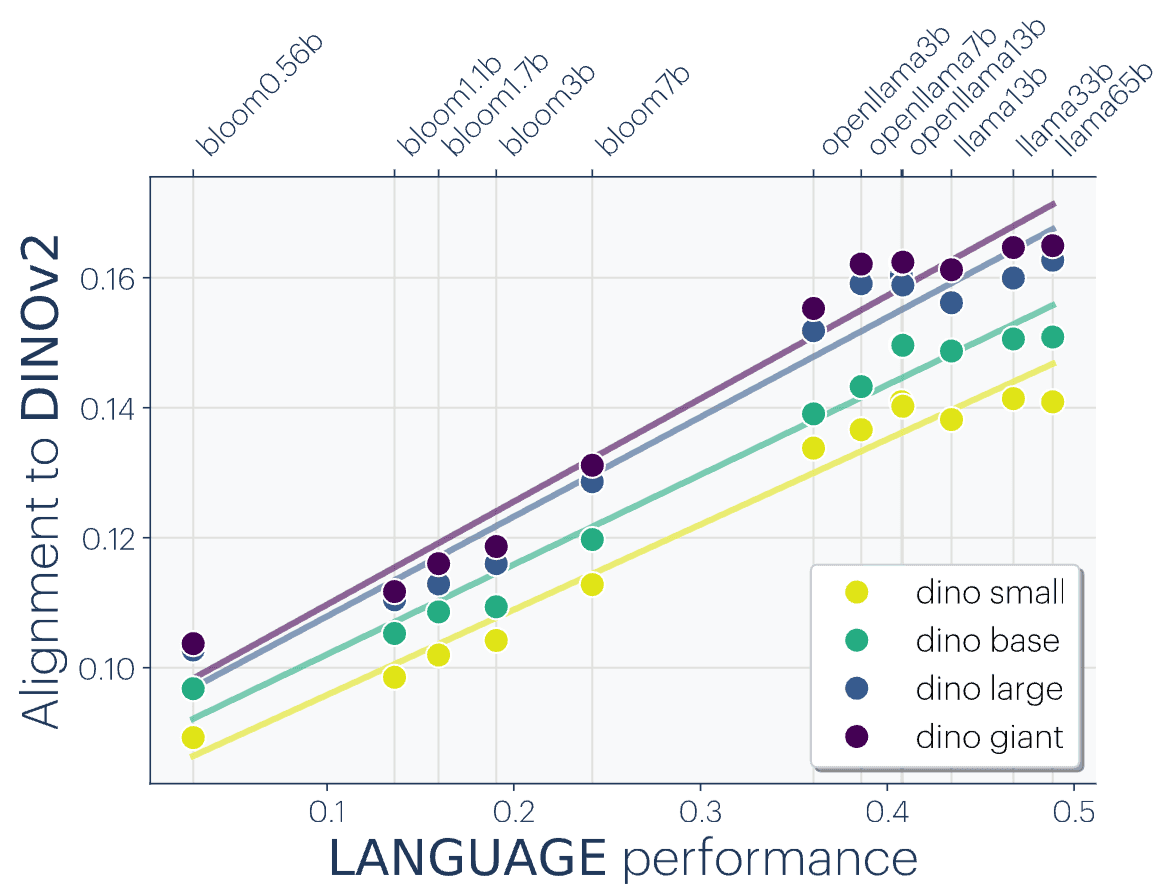
- Magnitude of alignment is weak at 0.16 (language-vision alignment)
- The metric for similarity matters (local and non-ordinal)
- Shared benchmarks and field-wide goal of human-like representations means that we could manufacture convergence
Notes
-
Similarity is measured via mNN (mutual k-nearest-neighbor): for each data point, does its top-k neighbors under kernel A (in space A) overlap with top-k under kernel B. (local, non-ordinal)
- 1.0 is not real ceiling (even if PRH is true) because of:
- information mismatch (not all observation pairs are bijective, e.g., “I believe in free speech” has no image that can convey it),
- finite-sample neighbor noise (data is noisy, which are true nighbors fluctuates)
- metric being all-or-nothing (11th neighbor in one space and 9th in other = zero credit)
- 1.0 is not real ceiling (even if PRH is true) because of:
-
Their cross-modality alignment tops out at around 0.16, which is ~16× chance but not high
Also see the  PRH revisited entry .